Costanza
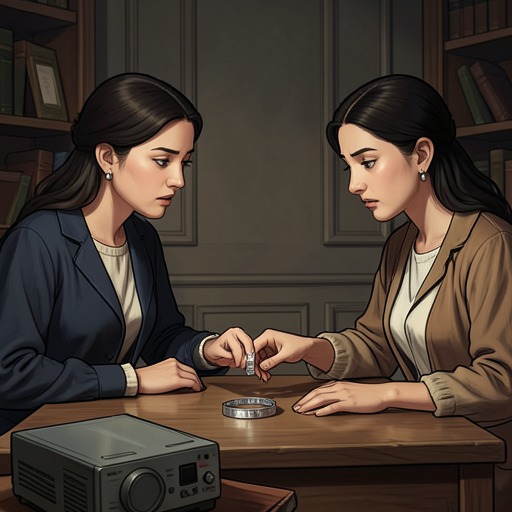
The Lying Life of AdultsCostanza is a teacher, the wife of Mariano, and the mother of Angela and Ida. To Giovanna, she is at once an admired figure of refinement and a family friend caught in the consequences of an adult relationship crisis. Her visit to return her white-gold bracelet becomes one of the quiet but decisive scenes through which Giovanna understands that the fracture between the households has altered the meaning of their friendship and of the objects passing between them.
Identity and Social Presence
Costanza teaches Italian and Latin, and her parents’ wealth enabled her to receive what Giovanna understands as an excellent upbringing. At dinners with the families, she appears polished and composed: her jewelry and carefully coordinated clothes impress Giovanna, who watches her closely and even finds herself imitating her manner. Costanza’s elegance contrasts with the more unruly humor of her husband, Mariano, and with the strain Giovanna notices in her own mother. She is not only an idealized adult in the child’s eyes; she is also part of the intimate social circle in which the families meet and the children grow up.
Her presence is especially vivid in small social exchanges. When Giovanna worries that she looks unattractive, Costanza reassures her by praising her ankles, while Mariano makes a joke that unsettles the girl. Costanza’s response places her among the adults who try to reassure Giovanna, but the scene also shows how closely the child studies the adults’ different ways of speaking and behaving. What seems like an ordinary family dinner becomes part of Giovanna’s education in how affection, humor, and discomfort coexist.
Family and Household Relationships
Costanza is married to Mariano, whose frequent joking and forceful manner make him a striking presence in the family circle. She is also mother to Angela and Ida, Giovanna’s friends. The girls’ home is a familiar setting for Giovanna, and her closeness to the sisters makes the friendship between the households consequential: adult conflict does not remain confined to the adults but changes how often the children see one another.
Costanza’s relationship with Giovanna’s parents is initially part of a longstanding friendship. At one gathering, Giovanna observes her mother and Mariano in an unusual, charged silence: her mother barely joins the conversation, while Mariano watches her and speaks to her softly. The adults negotiate whether Giovanna will stay overnight with Angela, and Mariano presses for the arrangement, promising to bring her home the next day. Giovanna senses that the discussion carries a meaning the children do not understand. The scene does not give her a clear explanation, but it establishes the charged atmosphere that later makes the households’ rupture legible to her.
The crisis becomes public in a confrontation at Costanza and Mariano’s apartment on Via Cimarosa. What begins as an argument about familiar intellectual and political topics escalates into shouting. Costanza leaves the apartment after Mariano directs an insult at her; Giovanna’s father follows her out. Angela and Ida are frightened, yet the adults do not explain the dispute to them. The children later suspect that the quarrel concerns the adults’ intimate lives rather than the subjects they had debated, but they are left to assemble its meaning from fragments.
The Bracelet and the Family Rupture
A few days after the confrontation, Costanza comes to Giovanna’s home without her daughters. Giovanna’s mother has visibly puffy, reddened eyes; Costanza’s expression is severe, and her fingers tremble as she helps Giovanna put on the white-gold bracelet. Giovanna initially thinks of it as a gift, but her mother corrects her: Costanza is returning it. The distinction turns the bracelet into a sign of restitution rather than generosity, although Giovanna is not told what has made it hers.
Costanza leaves with Giovanna’s mother and never visits the house again. Mariano, too, disappears from the family’s usual social setting on Via San Giacomo dei Capri, and Giovanna consequently sees Angela and Ida less often. The bracelet remains with Giovanna, worn day and night. Its passage from Costanza to the girl makes the adults’ concealed conflict tangible: an object associated with Costanza is now in Giovanna’s possession, while its transfer is surrounded by silence, strained looks, and explanations that withhold the underlying story.
The separation is not immediate or clean. Giovanna’s parents take nearly two years to decide to separate, and during this period her father is absent for weeks at a time. She later learns that he has been living in a house in Posillipo provided to Costanza by her parents, while Costanza is now permanently in conflict with Mariano. The adults’ relationships have rearranged the children’s social world as well as the marriages themselves. Giovanna’s parents agree that she should not see Vittoria, but the larger break also leaves her increasingly distant from Costanza’s household and from her friends.
Later Contact and Costanza’s Explanation
After a long estrangement, Costanza drives Giovanna toward Posillipo. Giovanna is careful not to disclose that she has repeated a school year, and she avoids asking about Angela. Costanza tells her that her daughters miss her and recalls Angela’s dream of losing a shoe that Giovanna found. Giovanna, meanwhile, fiddles with the bracelet, making its continued presence part of the encounter.
When Giovanna says that the children are not responsible for having stopped seeing each other, Costanza first falls silent, then insists that Giovanna’s father should not be blamed either. She says that people can cause harm without intending to, pulls over, and begins to cry. She tells Giovanna that her father feels badly, worries about her, misses her, and does not sleep; she adds that she and the girls miss her too. Costanza’s explanation refuses a simple assignment of blame, but its evasiveness leaves the young listener with an account of hurt that is real and consequential even when no one is presented as having intended it.
At another point, when Ida asks for the bracelet back, Costanza says that it belongs to Giovanna because she gave it to her, describing Giovanna as a good and studious girl. Her answer confirms the transfer without disclosing its original circumstances. The bracelet thus has more than one meaning in their relationship: it is returned amid the first rupture, worn by Giovanna through the years of uncertainty, and later defended by Costanza as something that is now the girl’s.
Narrative Significance
Costanza’s role is shaped by what Giovanna can see but cannot yet know. Her elegance and generosity make her an object of childhood admiration; her silences, trembling hands, and tears expose the limits of that child’s understanding. The narrative gives no single explanatory speech that resolves the adults’ conflict. Instead, it lets Giovanna infer significance from the sequence of a strained gathering, a violent argument, a bracelet returned, and a later attempt at reconciliation.
As a mother and friend caught between two households, Costanza also marks how adult intimacy reorganizes children’s loyalties and routines. The girls’ friendship is diminished by a crisis they did not cause and cannot interpret, while the bracelet carries forward a connection that the adults’ separation has made difficult to name. Costanza’s repeated effort to preserve contact with Giovanna does not restore the former family circle, but it keeps its emotional ties visible within the silence that follows.